
Tanoura Dance in Desert Safari Dubai: Experience the Magic of a Traditional Desert Performance
Dubai is widely known for its magnificent skyscrapers, luxurious hotels, modern shopping malls, and exciting attractions. However, another side of the city can be discovered far away from its busy urban streets. Beyond the modern skyline, a peaceful desert landscape is found where golden dunes stretch into the distance. Here, a traditional experience is offered through the famous Desert Safari Dubai.
A desert safari is not limited to dune bashing and adventure activities. Instead, a complete cultural experience is usually created for visitors. Traditional food is served, Arabic hospitality is provided, music is played, and different cultural performances are presented. Among these performances, Tanoura Dance in Desert Safari Dubai is especially admired because of its colorful costume, continuous spinning, rhythmic movements, and fascinating presentation.
Moreover, the performance is made even more attractive by the desert environment. When the sun goes down and the evening sky begins to darken, the traditional camp is illuminated with beautiful lights. At this point, the Tanoura performance is often presented, and the attention of the audience is immediately captured.
For tourists visiting Dubai for the first time, this performance can become one of the most memorable parts of a desert evening. Therefore, Tanoura is not simply watched as a dance; instead, it is experienced as a combination of culture, music, movement, and entertainment.
What Is Tanoura Dance?
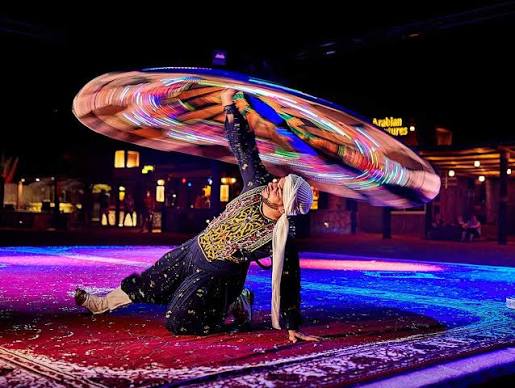
Tanoura is a traditional dance that is recognized mainly for its spinning movements and colorful circular costume. During the performance, a dancer is seen rotating continuously while wearing a large, decorated skirt. As the spinning is increased, the skirt is spread outward, and a beautiful circular shape is created.
Although the movement may appear simple to the audience, a great deal of practice is required to perform it successfully. Balance must be maintained, the rhythm must be followed, and the costume has to be controlled throughout the performance. Furthermore, the dancer is expected to remain energetic even while spinning repeatedly.
The word “Tanoura” is associated with the skirt worn by the performer. Over time, the dance has been developed into a recognizable folkloric performance. It has also been influenced by traditions of Sufi whirling, although the modern folkloric version is presented mainly as a cultural and artistic performance.
Today, Tanoura is enjoyed by visitors in different parts of the Middle East. In Dubai, it has been included in many desert safari entertainment programs because of its colorful and visually impressive nature.
A Glimpse Into the History of Tanoura
The history of Tanoura is connected with traditional whirling practices that have existed in the Middle East for centuries. In particular, Egyptian Tanoura developed its own distinctive style and became an important part of Egyptian folklore.
Originally, whirling movements were associated with spiritual practices. Through time, however, the performance was transformed into a form of folk entertainment. Different costumes, musical styles, and movements were gradually introduced, and the colorful Tanoura performance that is recognized today was developed.
Nevertheless, its historical background can still be noticed in the circular movements of the dancer. The repeated spinning is often associated with ideas of continuity, movement, and spiritual reflection.
In modern tourism, Tanoura is generally presented in a theatrical manner. Consequently, bright costumes and energetic music are used to make the performance more attractive to audiences.
When the dance is presented at a Dubai desert camp, its traditional elements are combined with a modern entertainment environment. As a result, visitors are provided with an opportunity to enjoy a cultural performance while spending an evening in the desert.
Why Is Tanoura Included in Desert Safari Dubai?
A desert safari is designed to provide a complete experience rather than a single activity. Therefore, several forms of entertainment are usually included in evening safari packages.
First, visitors may be taken across the dunes in a 4×4 vehicle. Then, activities such as camel riding, sandboarding, or other desert experiences may be offered. Afterward, guests are commonly taken to a desert camp where dinner and entertainment are provided.
At this stage, cultural performances can be enjoyed.
Tanoura is particularly suitable for this environment because it is highly visual. Even if visitors do not understand the language of the music or announcements, the performance can still be appreciated.
Furthermore, the colorful costume becomes extremely attractive under artificial lighting. The movement of the dancer creates a constantly changing visual effect, and therefore the attention of the audience is naturally drawn toward the stage.
The Colorful Tanoura Costume
One of the most fascinating features of Tanoura Dance is its costume.
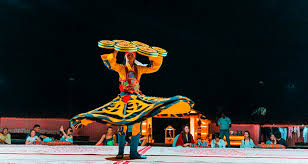
A large, circular skirt is worn by the dancer, and several layers of fabric may be included. Different colors and patterns are often used so that the costume becomes more impressive while spinning.
When the dancer begins to rotate, the fabric is gradually opened outward. Eventually, a wide circular shape is created around the performer. Because of this effect, the dancer can appear to be surrounded by a colorful moving wheel.
The costume is not simply worn for decoration. It is an essential part of the performance and is used to create the visual effect for which Tanoura is known.
Moreover, the costume must be handled carefully. Its weight, size, and movement can make the performance more challenging. Therefore, considerable skill is required from the dancer.
Under the lights of a desert camp, the colors can appear even more vibrant. Consequently, the costume becomes one of the first things noticed by tourists.
The Fascinating Spinning Movement
The spinning movement is the heart of Tanoura Dance.
At the beginning, the dancer may move slowly. Gradually, the speed is increased, and continuous rotation is performed. Meanwhile, the costume is allowed to spread outward.
For spectators, the movement can appear almost effortless. However, a strong sense of balance is required. The performer must remain controlled while rotating for an extended period.
In addition, the dancer’s movements have to remain synchronized with the music. Therefore, physical stamina, coordination, concentration, and experience are needed.
As the performance continues, the audience is often drawn deeper into the visual experience. The repeated circular movement can create a fascinating effect, especially when it is combined with music and lighting.
Furthermore, the desert environment adds another layer to the performance. Instead of being presented inside a crowded theater, Tanoura is experienced in an open desert setting, where the surrounding landscape becomes part of the atmosphere.
Tanoura Dance Under the Desert Sky
An evening desert safari provides a unique setting for Tanoura.
During the daytime, the desert can be bright and extremely warm. However, as the sun begins to set, the atmosphere becomes more comfortable and peaceful. The dunes are covered with soft evening light, and eventually the night sky appears above the camp.
At this time, traditional entertainment is often started.
When the Tanoura dancer appears, the performance area becomes the center of attention. Camp lights illuminate the costume while music is played in the background.
As a result, a beautiful contrast is created between the dark desert surroundings and the bright colors of the dancer’s costume.
Moreover, the absence of city noise makes the experience feel different from ordinary entertainment. The performance is surrounded by open space, sand dunes, and the peaceful atmosphere of the desert.
For this reason, Tanoura Dance is often remembered long after the safari has ended.
The Importance of Music
Music plays an important role in Tanoura performances.
The rhythm is used to support the dancer’s movements, and the atmosphere is gradually built through musical patterns. As the performance develops, the rhythm may become more energetic, and the spinning may be intensified.
In addition, traditional instruments and rhythmic sounds can be used to create a cultural atmosphere.
Although the exact music can vary between performances, its purpose remains similar: the audience is engaged, and the dancer’s movements are supported.
Because music and movement are closely connected, the performance becomes more than a visual display. Instead, it becomes a complete sensory experience.
Visitors are able to hear the rhythm, watch the colorful movements, and experience the atmosphere created around them.
Tanoura and Middle Eastern Culture
Cultural performances are an important part of tourism because traditions can be introduced to people from different backgrounds.
Tanoura provides visitors with a glimpse into the artistic traditions of the Middle East. Its history, costume, music, and spinning movements are connected with a long cultural development.
Although the performance presented at a tourist camp is often adapted for entertainment, its traditional character is still maintained through clothing, music, and movement.
Therefore, visitors can enjoy the performance while also becoming curious about its origins.
In addition, cultural shows help make a desert safari more meaningful. Adventure activities provide excitement, while cultural performances provide an opportunity to observe traditional art.
As a result, the two experiences complement each other.
A Memorable Experience for Families
Tanoura Dance can be enjoyed by people of different age groups. Children are often attracted to the bright colors and unusual spinning movements, while adults may be more interested in the cultural and artistic aspects.
For families, the performance provides a relaxing activity after the day’s desert adventures.
After dune bashing or other activities have been completed, guests can sit comfortably at the camp. Food and refreshments may be served, and entertainment can then be enjoyed.
Furthermore, the performance can become a shared family memory. Photographs may be taken, and children can watch the colorful costume as it moves across the stage.
Therefore, families looking for both entertainment and culture can find Tanoura to be an enjoyable part of their safari.
Tanoura Dance for Couples
An evening desert safari can also be enjoyed by couples.
After spending time in the dunes, couples can relax at the desert camp while cultural performances are presented. Among them, Tanoura can provide an entertaining and visually attractive experience.
The warm camp lighting, traditional setting, music, and colorful performance can create a pleasant atmosphere.
Moreover, the desert provides an opportunity to escape the busy environment of central Dubai. Instead of traffic, shopping centers, and skyscrapers, visitors are surrounded by sand dunes and an open night sky.
Consequently, a desert safari can be made into a memorable evening for couples.
Photography During Tanoura Performance
Tanoura is also a popular subject for photography.
Because the dancer is continuously moving, interesting photographs can be captured from different angles. The large spinning skirt creates unusual shapes, and every moment of the performance can look slightly different.
However, photographs should be taken respectfully. Visitors should follow the instructions of the safari camp and avoid disturbing the performer.
For better photographs, it is often useful to capture the entire performance area rather than focusing only on the dancer. When the desert background, camp lights, and audience are included, the photograph can provide a stronger sense of place.
Furthermore, short videos can be recorded if photography and recording are permitted.
Tanoura After Dune Bashing
Dune bashing is one of the most exciting activities included in many desert safari packages. Powerful 4×4 vehicles are driven across the dunes, and thrilling climbs and descents are experienced.
However, after this energetic activity, a calmer form of entertainment is welcomed.
Tanoura provides exactly this change in atmosphere.
After the excitement of driving across the dunes, visitors can sit down and watch the performance. Gradually, the focus is shifted from adventure to culture.
Therefore, Tanoura helps create a balanced safari program in which excitement and relaxation are combined.
A Different Side of Dubai
Dubai is often represented through its modern architecture and luxurious lifestyle. Nevertheless, the city’s desert provides an opportunity to experience something completely different.
Traditional activities are presented, Arabic-style hospitality is offered, and cultural performances are enjoyed.
Tanoura is one of the performances through which this contrast can be experienced.
While the modern city is filled with glass towers and advanced technology, the desert camp is often designed around traditional themes. Consequently, visitors are provided with a chance to experience an atmosphere that feels connected to the region’s cultural heritage.
This combination of modernity and tradition is one of the reasons Dubai remains such an attractive destination.
What Makes Tanoura Different From Other Dance Performances?
Tanoura has a distinctive visual identity.
Many traditional dances involve coordinated steps, group formations, or hand movements. Tanoura, on the other hand, is primarily recognized for continuous spinning.
The large costume makes the movement even more noticeable. As the dancer rotates, the skirt expands and creates a dramatic circular effect.
Moreover, the performance is often built gradually. The dancer may begin with controlled movements before the speed is increased.
Because of this structure, anticipation is created among the audience.
By the time the performance reaches its most energetic stage, the audience is usually fully engaged.
How to Enjoy Tanoura Dance During a Safari
To get the most from the experience, a few simple things should be kept in mind.
First, an evening safari should be selected if cultural entertainment is a priority. Secondly, the safari package should be checked beforehand to make sure Tanoura is included.
Furthermore, visitors should arrive at the camp with enough time to settle comfortably before the show begins.
During the performance, attention should be given not only to the spinning but also to the costume, music, lighting, and atmosphere.
Instead of watching the performance casually, visitors can observe how the dancer maintains balance and how the costume changes as the speed increases.
As a result, the performance can be appreciated on both artistic and cultural levels.
Tanoura as a Cultural Attraction
Tourism allows traditional art to be introduced to international audiences. Through performances such as Tanoura, visitors can be exposed to cultural traditions that they may not otherwise encounter.
However, cultural performances should be appreciated respectfully. The history and background of the art should be recognized rather than being viewed only as entertainment.
When this approach is taken, the experience becomes more meaningful.
Tanoura can therefore be appreciated for its visual beauty while its cultural background is also respected.
Why You Should Include Tanoura in Your Dubai Desert Safari
There are many reasons why Tanoura deserves attention during a desert safari.
First, it is visually impressive. Secondly, it is connected with traditional Middle Eastern performance culture. Thirdly, it can be enjoyed by people of different ages.
Moreover, the performance is usually presented in an atmosphere that is very different from ordinary city entertainment.
The desert setting, evening sky, camp lights, music, and colorful costume are brought together to create a memorable experience.
For tourists who want to experience more than adventure, Tanoura can be an excellent addition to the safari.
Conclusion
Tanoura Dance in Desert Safari Dubai represents a beautiful meeting point between tradition and modern tourism. Through colorful costumes, rhythmic music, continuous spinning, and carefully prepared performances, an unforgettable atmosphere is created for visitors.
Although the dance has developed through a long cultural history and has connections with traditional whirling practices, its modern folkloric form is now enjoyed by audiences around the world.
Furthermore, when Tanoura is performed in the Dubai desert, an additional sense of magic is created. The golden dunes are replaced by the darkness of night, camp lights illuminate the performance area, and the colorful skirt begins to spin against the desert background.
As a result, the performance becomes more than a simple dance show. It becomes a cultural experience that is remembered for its colors, movement, music, and atmosphere.
Therefore, when a Desert Safari Dubai experience is being planned, Tanoura Dance should not be overlooked. After the excitement of dune bashing, camel riding, and other desert activities, a traditional performance can be enjoyed while relaxing at the camp.
Ultimately, Tanoura demonstrates that the Dubai desert is not only a destination for adventure. It is also a place where culture, tradition, entertainment, and hospitality can be brought together. For visitors seeking a memorable evening away from the modern city, the mesmerizing whirl of Tanoura can provide a truly fascinating desert experience.